Validating the right brand architecture for the next era of a California sparkling icon.
J Vineyards & Winery
E. & J. Gallo asked us to validate the right brand architecture for J Vineyards & Winery. The brief was to give one of California’s most respected sparkling wine houses the structure it needed to evolve, elevate and grow into the brand it could be. Over four months, the work locked the future state brand architecture. It also clarified the more than $150M of brand equity at stake in getting the decision right.
Client: J Vineyards & Winery (E. & J. Gallo) Sector: Luxury wine and hospitality Scope: Brand architecture, brand strategy, brand definition, design territories Engagement: Four-month brand architecture phase, followed by a full brand development programme delivered in partnership with Gallo’s in-house design team
J Vineyards & Winery is one of California’s most respected producers of traditional-method sparkling wine. Founded by Judy Jordan, anchored in the Russian River Valley, and part of the Gallo portfolio, J has spent its life building genuine reputation across both sparkling and still wines, a much-loved winery and tasting room, and a wine club whose loyalty and engagement is well known in the category.
By 2022, the brand was wrestling with a set of inter-related challenges that no single intervention was going to fix on its own.
J’s brand equity was being compromised. The California tier, the most visible and most widely distributed expression of the brand, accounted for roughly 82% of J’s distribution and an estimated 25 million annual visual contacts. The Halo and Small Lot wines, the prestige expressions where the brand wanted to be admired most, reached fewer than 400,000.
Cannibalisation had become a real commercial issue. Cuvée 20 at $38 was steadily losing share to a near-identical California Cuvée at $25. Same shelf, same shape, no obvious reason for the consumer to trade up. Trading down had begun to feel structural rather than seasonal.
And the rest of the brand system was not doing enough to help. Tier names were opaque. Pricing felt unconfident. Distribution decisions had become indoctrinated rather than designed. The visual identity, the iconic J swoosh aside, was looking flat and underconfident next to a refreshed competitive set of Nyetimber, Gusbourne, Domaine Carneros and the resurgent European Champagne houses.
The remit from the senior brand team at Gallo was to identify and validate the right brand architecture for J’s future. One that resolved the tier confusion, protected the brand’s equity, and gave each part of the portfolio the room it needed to perform.
It is a familiar instinct, and a dangerous one.
In 2015, Marc Jacobs took exactly this decision, retiring its endorsed Marc by Marc Jacobs diffusion line to defend the core. The intention was to elevate. The outcome, according to industry analysts, was an 80% collapse in income. The diffusion tier had been doing far more than its critics gave it credit for. It was the bridge to a younger audience, the energiser of the master brand, and the mechanism by which new consumers found their way in. Once it was gone, the parent brand had no obvious way of recruiting anyone new.
Validating the right architecture for J meant taking the California instinct seriously enough to test it rigorously, rather than designing around it or dismissing it. The question that mattered most for the leadership team was the prior one. Did the organisation as a whole actually understand where J’s brand equity was coming from, before any architecture decision was committed to?
So that became the question we worked.
Over four months we ran a programme of insight, engagement and structured debate designed to surface the truth and align the leadership around it.
A brand and architecture questionnaire went out to the full cross-functional team (winemakers, brand and marketing, sales, PR and trade, winery operations, events, customer experience, DTC and the club), exploring purpose, audience, tier definition, values, personality, positioning, the winery experience and the SWOT of the existing architecture. The questionnaire was deliberately open-ended, designed to reveal divergent thinking as much as convergent thinking.
Three cross-functional teams then went through two focus group workshops each, six sessions in total. Session one took on the brand foundations: purpose, values, personality, positioning. Session two took on architecture, tiering, distribution and the business implications of change. Each workshop was designed with minimal visual guidance, so respondents were not quietly led toward a preferred answer.
We interviewed executives, including Judy Jordan herself, to surface the founder’s intent and the spirit that had built the brand. We analysed the competitive set and the wider reference group (Soho House, Daylesford, Argiano, Ashes and Diamonds, Nyetimber, Veuve Clicquot, Domaine Carneros, Flowers, Aperture, Scribe, Gusbourne, Möet & Chandon) to understand where J sat in the global picture and where the genuine white space was.
And we ran a staged sequence of stakeholder sessions with Joe Gallo and the senior brand team, from the October debrief through November’s working sessions and December’s business case, to the January recommendation. Each session was a chance to share the latest thinking, test it against the leadership’s instinct, and build the alignment that would carry the architecture decision into the rest of the business.
This was a methodology built on engagement as much as on rigour. By the time we presented the architecture recommendation, the leadership team had already done the reasoning with us.
We asked the room to look at the distribution mathematically. 214,777 cases of California-tier wine, twelve bottles per case, an estimated ten visual contacts per bottle as it moves through the consumer journey. Roughly 25.7 million eyes on J each year. The small-lot wines, by comparison: 10,300 cases, twelve bottles, three eyes per bottle, totalling 370,800 contacts. A seventy-to-one ratio.
Then the obvious question. If you remove the California tier, where do those 25 million annual brand impressions come from? Who recruits the next generation of J consumers? What happens to visitation when the most accessible expression of J disappears from the shelf?
The room shifted. The language in the workshops moved from “remove it” to “how do we make it work.” Discussions became less emotive and more business-led, and the team began to engage with the architecture question on the terms it actually deserved.
The follow-up insight made the same point from a different angle. The California tier was not damaging J’s prestige in any objective sense. It was creating consumer confusion because nothing else in the brand system was helping a consumer make sense of the hierarchy. The conclusion was that the architecture had been asked to do work that the rest of the brand system should have been doing alongside it. Definition, design, naming, pricing and distribution all contribute to consumer clarity, and all of these had been allowed to drift.
A sharper recommendation followed from that realisation.
The recommendation, accepted was the master-brand structure.
J Vineyards & Winery as the master brand, holding the vision, mission, positioning, core values and master brand identity. Underneath, four sub-brands (California, Russian River Valley, Small Lots and Halo), each with its own defined consumer target, consumer insight, brand proposition and a flexed visual and verbal identity that lets it speak in its own register while remaining unmistakably J.
The logic was disciplined.
A branded house had stopped serving J because every tier was being made to behave like every other tier. The result was confusion at the shelf and trading down inside the family. A pure endorsed model, by contrast (California spun out, J protected upmarket), would have severed J from the engine that recruits new consumers and brings 25 million annual impressions. There was no guarantee that a standalone California brand could be built without years of investment and considerable risk. The Marc Jacobs lesson sat squarely on the table.
Sub-brands let us have both. California gets to be fresh, bold, expressive and unashamedly Californian: the conversation starter, the recruitment vehicle, the lifestyle face of the brand. Russian River Valley gets to be premium, sophisticated, accessibly aspirational. Small Lots gets to be refined, creative, and textural. Halo gets to be exclusive, pared back, the luxury expression. Each tier holds its own brand universe while connecting through the master. The portfolio finally tells a coherent story to consumers, to trade and to the team.
Migration framework. A phased plan for moving from the existing branded house to the new architecture, sequencing immediate, near-term and long-term work across brand, design, naming, marketing and distribution. The phasing was designed so that change could be managed without destabilising existing equity.
A new brand universe. A full brand platform built around a shift from status seekers to pleasure seekers as the primary opportunity target. New purpose, vision, mission, consumer insight, consumer reward, values and personality, all designed to give J the foundations to compete in the genuine blue ocean as California’s answer to traditional Champagne, rather than as another player in a crowded European-heritage category.
Brand positioning and narrative for J California. A new strategic and creative platform for the refreshed California tier, leaning into the lifestyle, the self-expressive and the emotional territory the architecture decision had opened up. The narrative defines what California stands for as a sub-brand within the J family: distinct enough to be its own thing, connected enough to do its job as the recruitment engine.
Naming recommendations across tiers. A revised naming system designed to give consumers and trade clear, intuitive cues to read the hierarchy, and to resolve specific confusions (Cuvée 20 versus California Cuvée among them) that had been driving trading down.
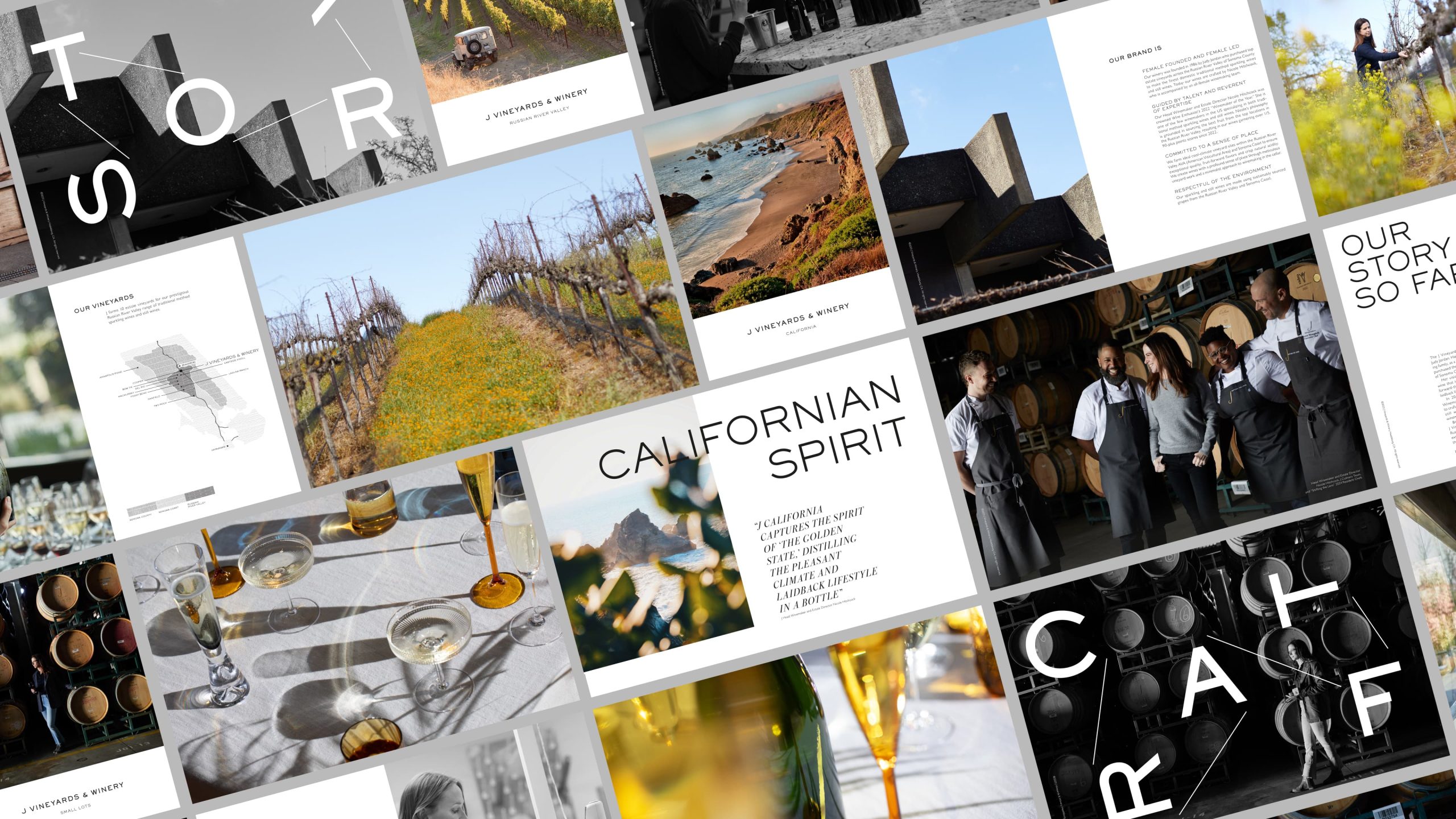
Brand design territories. Developed in partnership with Gallo’s in-house design team, a series of creative territories to inspire new packaging and visual expression across the architecture. The territories give the in-house team a defined creative framework to evolve packaging, identity and brand experience tier by tier, without losing the family resemblance that holds the portfolio together.
The numbers tell the story directly. The California tier moves roughly 214,777 cases a year. At the documented California Cuvée price point of $25 retail, that’s around $64M in retail value, translating to approximately $32M in annual wholesale revenue. With California accounting for 62% of J’s 2021 sales, total J wholesale revenue sits in the $50M+ range.
Cutting California (the option that had emerged through the discovery work as a serious possibility) would have meant an immediate ~$32M annual hit to wholesale revenue. Rebuilding a standalone California brand from scratch typically takes five to seven years with no guarantee of success, which is why the Marc Jacobs precedent of an 80% income collapse sits so heavily on these decisions.
Conservatively, the avoided downside is in the order of $150M+ over five years in directly-attributable revenue alone. That figure is before accounting for the loss of 25 million annual brand impressions, the collapse in winery visitation, the impact on wine club lifetime value, the marketing spend required to rebuild recruitment, and the brand equity that would have walked out of the door with it.
That is what good strategic brand architecture is for. Its purpose is to produce the clarity that lets a leadership team make a decision of this scale with confidence, and to surface the implications, financial and otherwise, that need to be on the table before the decision is committed to.
The brief is rarely the brief. We were asked to validate the right architecture for J’s future. The work that mattered most was the work that surfaced the real question underneath: where J’s brand equity was actually coming from, and what was at stake in any architecture decision that did not begin from that understanding. Indeed, the most valuable thing an outside agency brings to a brand problem is the discipline to interrogate the premise before solving for it.
Architecture and brand definition are the same problem. Most architecture confusion is, in our experience, definition, design, naming, pricing or distribution confusion in disguise. Restructuring the org chart of a portfolio does not fix a brand that hasn’t decided what each part of it stands for. We always test both at once, and the deliverables we produce reflect that, defining each tier as its own brand universe rather than as a box on a chart.
Pleasure is the new prestige. The luxury consumer today is motivated by experience, meaning, curiosity, craft and conviviality. Status still matters, but it has become a secondary motivator behind these others. Brands that continue to pitch at status seekers are pitching at a shrinking audience, and underestimating the pleasure-seeker audience that is actually growing. The J brand universe was rebuilt on that insight, and it has implications for almost every luxury and prestige brand we work with.
The room has to arrive with you. A recommendation handed down from outside does not change minds, especially in organisations with strong cultures and long memories. Every exercise in this project (from the questionnaire and the workshops, through the equity reframe and the CEO-for-a-day session, to the staged stakeholder sessions with Joe Gallo and the senior team) was designed so that by the time the recommendation was presented, the leadership team had already arrived at it. Alignment of this kind is built through the engagement itself rather than imposed at the end of it.
Spinach is an independent branding agency working with category-leading clients on brand strategy, identity development and brand activation. If you have a portfolio question, an architecture decision in front of you, or a brand you want to grow into something bigger, we’d love to hear from you.